Report on Joint Research Findings
Fiscal 2025
Principal Research
1. Survey of Kubo Sakae Materials
2. Research on Postwar shingeki with a Focus on the Kurabayashi Seiichiro Collection
3. Research on Prewar Film Screenings Using Film-Related Materials
4. Research on the Systematic Organization of Materials Related to the Tiny Alice
5. Survey of Maeda Naoki Materials
Selected Research
1. Basic Research on the Okamoto Kido Collection
2. Literary Circles of the Mid-Edo Period, Through Diaries of kabuki Actors
3. Empirical Research on Regional Theater Under the GHQ (SCAP) Occupation: Focusing on the Kyushu Area
4. Research on Kodan Materials in the Tanabe Koji Collection
5. Overview Survey of Print Inventory Left Behind by Sakagawaya, the Original Publisher of Tokiwazu-bushi
6. Research on the Concept of “History of Japanese Performing Arts” in the Ozawa Shoichi Collection: Focusing on Changes in Sexual Expression
Principal Research 1
Survey of Kubo Sakae Materials
Principal Researcher
Abe Yukako (Professor, Faculty of Arts and Letters, Kyoritsu Women’s University)
Collaborative Researchers
Akai Kimi (Associate Professor, Graduate School of Arts and Letters, Tohoku University)
Kumagai Tomoko (Research Assistant, Theatre Museum, Waseda University)
Fujisaki Kei (Meiji University Graduate School)
Research Objectives
This study organizes, examines, and investigates unorganized and unpublished materials in The Theatre Museum’s Kubo Sakae Collection. Kubo Sakae (1900-1958) was a playwright and director who led the world of Japanese shingeki (new drama) from prewar to postwar Japan. The project particularly focuses on his relationship with Tsukiji Shogekijo. In 1926, Kubo entered the literary department of Tsukiji Shogekijo and studied theater under Osanai Kaoru and Hijikata Yoshi; after Osanai’s death, he produced a series of masterpieces. Kubo’s experiences at Tsukiji Shogekijo and the influence of Osanai were significant in his creative activities. By examining these experiences, we believe that we can solidify the foundation for basic research on Kubo Sakae based on primary sources.
Summary of Research
Kubo Sakae was involved in the activities and founding of various shingeki theater troupes. He was a writer who occupied a major position in the shingeki world before and after World War II. However, currently, research on Kubo Sakae can hardly be said to be making progress. The Theatre Museum received a vast collection of materials donated by Kubo’s adopted daughter, Kubo Masa. These materials, which are largely unorganized, require urgent organization to serve as a basis for research on Kubo Sakae.
In the last academic year, we sorted and organized various mixed materials, which were then cataloged focusing on manuscripts, notebooks, and letters in Kubo Sakae’s handwriting. This academic year, while continuing these operations, we began to sort and organize miscellaneous materials that are difficult to classify.
These materials were a mix of newspaper clippings, notes, fragmented diaries and schedules, photographs, letters, rights-related documents, and more. Much time was devoted to individually examining each material and considering preservation methods and cataloging.
Through this organization process, a number of valuable materials were discovered, including materials related to Osanai Kaoru, Kubo Sakae’s mentor, and a diary that Kubo kept during his final years, while recuperating from illness. Among the materials related to Osanai Kaoru were a menu (signed by Osanai) for a farewell party held at Mon Ami in Ginza before Osanai traveled to Moscow in 1927 and a postcard dated December 2, 1927, sent from Moscow to members of Tsukiji Shogekijo. The postcard included words of appreciation for the troupe members and plans to see a performance of Romashov’s The Soufflé (Kukimanju), and described Osanai’s vibrant experiences during his stay in Moscow. The fact that Kubo carefully preserved the menu and other materials signals the importance of Osanai’s presence in his life.
Project team member Kumagai Tomoko also reprinted and introduced postcards from Osanai Kaoru held by The Theatre Museum (see Kumagai Tomoko, “Introduction of Materials: Postcards from Osanai Kaoru (addressed to Osanai Tomeko),” Studies in Dramatic Art, No. 49). It is our hope that these materials, when examined together with other existing materials in the collection, will contribute to the development of research on Osanai Kaoru. After organizing and investigating the Kubo Sakae materials and examining their relationship with Tsukiji Shogekijo, Akai Kimi, Kumagai Tomoko, and Fujisaki Kei presented their findings in a panel session entitled “shingeki and Performances as Seen in the Waseda University Theatre Museum Collection,” held at the 2025 National Conference of the Japanese Society for Theatre Research, Hiroshima University Higashihiroshima Campus, on June 22, 2025 (the panel discussion was led by The Theatre Museum director Kodama Ryuichi).
In an attempt to present shingeki-related materials held by The Theatre Museum from the perspective of “performances,” Akai examined wartime touring theater using letters from the Kubo Sakae Collection and materials from the Cabinet Intelligence Bureau. Based on Tsukiji Shogekijo’s sales receipts, Kumagai clarified the aspect of Tsukiji Shogekijo’s performances as a theater company, and Fujisaki discussed Tsukiji Shogekijo as a theater. Principal researcher Abe Yukako joined also the discussion.
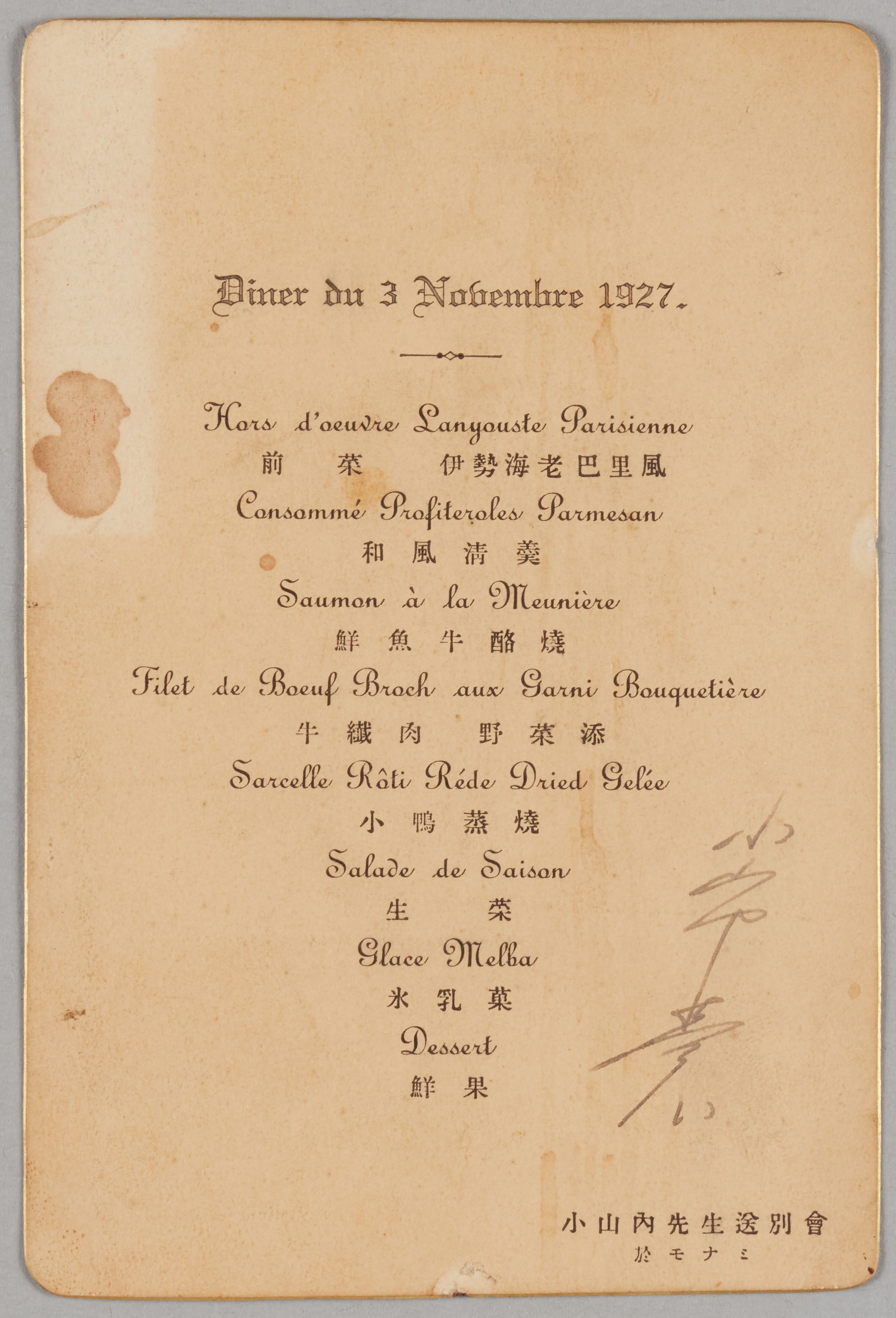
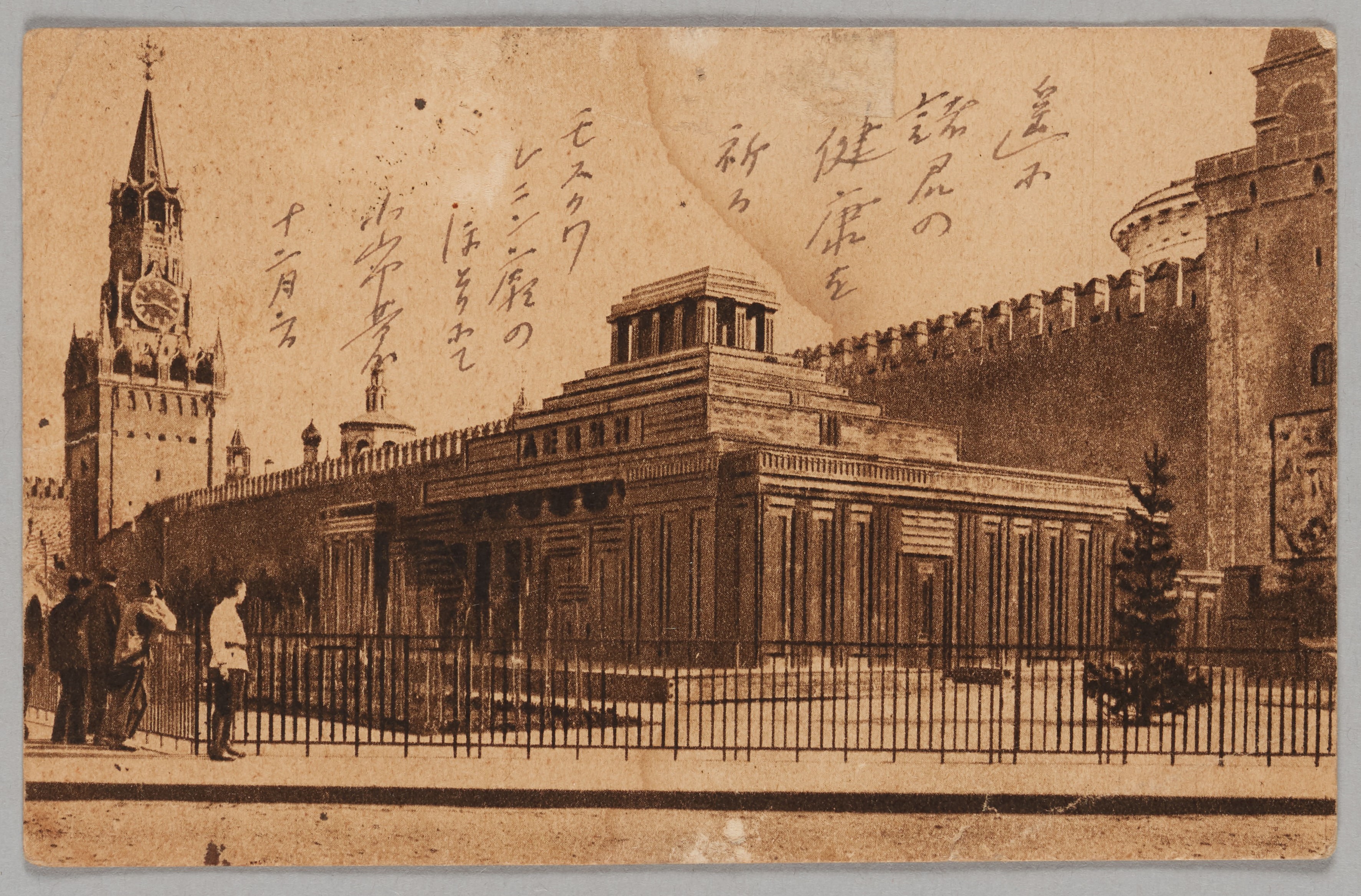
Image 1:Osanai Kaoru’s farewell party menu
Image 2:Postcard from Osanai Kaoru (from Russia)
From a scrapbook of materials related to Kubo Sakae[72479]
Principal Research 2
Research on Postwar shingeki with a Focus on the Kurabayashi Seiichiro Collection
Principal Researcher
Goto Ryuki (Research Fellow, The Edogawa Rampo Memorial Center for Popular Culture Studies, Rikkyo University)
Collaborative Researchers
Kamiyama Akira (Emeritus Professor, School of Arts and Letters, Meiji University)
Kodama Ryuichi (Professor, Faculty of Letters, Arts and Sciences, Waseda University)
Yoneya Naoko (Cultural policy and arts management advisor)
Fujiya Keiko (Librarian, Waseda University)
Research Objectives
Kurabayashi Seiichiro (1912-2000) joined the Haiyu-za Gekidan Theater Company in 1946, shortly after Japan’s defeat in World War II. He founded the Haiyu-za Theater in 1956 and was appointed its CEO in 1981. In 1965, he was instrumental in establishing Japan’s first unified body of performance artists, the Japan Council of Performers Rights & Performing Arts Organizations (Geidankyo). This organization significantly influenced the protection of performers’ rights, encouragement of cultural activities, and policy advocacy in the performing arts.
This study aims to reassess Kurabayashi Seiichiro as a theater producer through research and examination of diaries, scrapbooks, memos, notebooks, letters, and other materials in the Kurabayashi Seiichiro Collection, and to lay the foundation for basic research on postwar shingeki. The importance of the “theater producer,” defined by Kurabayashi himself as “existing between the creative organization and the audience, and playing an important role in objectively and correctly understanding the positions and ideas of both parties and communicating them to each other” (The Theatre Producer), cannot be overlooked when considering audience theory in the theater. However, producers have not yet been considered as a subject of research. By clarifying Kurabayashi’s achievements, this project aims to measure the influence of the producers who actually managed theater venues and put on performances, to open up perspectives on theatrical (theater historical) research not limited to the viewpoints of writers, directors, actors, and other creatives, and to clarify the multifaceted nature of postwar shingeki performances, among others.
Summary of Research
This academic year, we continued transcribing the 79 volumes of diaries written by Kurabayashi Seiichiro from June 1947 to March 2000. Among these diaries, we transcribed and reviewed those written from 1947 to 1952, during the Occupation period. Project members are working on a book entitled The Diaries of Kurabayashi Seiichiro: The Occupation Period, which will be published in 2026, along with explanatory notes, discussions, and more. These diaries will contribute to the study of postwar shingeki (theater), and through Kurabayashi’s detailed descriptions of the behind-the scenes of performances, will vividly convey the realities not only of shingeki but also of theater and film during the Occupation period.
Furthermore, the project held a public research meeting entitled “Aspects of Sino-Japanese Cultural Exchange and Theatre: Postwar Theatrical Materials and Their Context” (October 21, 2025). Kurabayashi Seiichiro was part of a Japanese theater delegation to China (1957) and the first shingeki theater troupe to visit China (1960) as director general. The Theatre Museum received a donation of materials related to these activities. The second (1965) and third (1981) shingeki theater troupes to visit China, led by Senda Koreya and Sugimura Haruko, went on to stage a variety of plays. Postwar shingeki-related materials were exhibited in conjunction with The Theatre Museum’s 2025 Fall Special Exhibition, “Sino-Japanese Theatrical Exchange: Ouyang Yuqian, Tian Han, and Japan,” as evidence of theatrical exchange between Japan and China. The exhibition also provided an opportunity to consider various roles that theater played in cultural exchange between these two countries.
First, Kumagai Tomoko (Research Assistant, Theatre Museum) gave an overview of the exhibition on “Sino Japanese Theatrical Exchange” and reported on the exhibited materials. Next, Goto Ryuki introduced materials from the Kurabayashi Collection related to shingeki theater troupes visiting China, adding that the anti-US movement against the Security Treaty had a significant influence on solidarity between Japanese and Chinese cultural figures. Following these activities, theater critic Ozasa Yoshio took the stage, with Theatre Museum director Kodama Ryuichi serving as interviewer. Ozasa talked extensively about the realities of the time, aspects of Sino-Japanese theatrical exchange, and present-day issues.
The diaries written after the Occupation period date back to the construction and opening of the Haiyu-za Theater (closing in 2025). Additionally, we will be seeking opportunities to conduct research on materials other than diaries.
Principal Research 3
Research on Prewar Film Screenings Using Film-Related Materials
Principal Researcher
Okada Hidenori (Curator, National Film Archive of Japan)
Collaborative Researchers
Kamiya Makiko (Part-time Lecturer, Musashino Art University)
Shibata Kotaro(Junior Research Fellow, Research Institute for Letters, Arts and Sciences, Waseda University)
Shirai Fumito (Associate Professor, Faculty of Business and Commerce, Keio University)
Research Objectives
This study examines movie theater screening programs, benshi performers’ and musicians’ practices, and changes in film distribution methods by analyzing film promotional materials, mainly movie theater flyers in the Theatre Museum’s collection, from the dawn of cinema to the prewar period. The purpose of this analysis is to clarify various aspects of Japanese film distribution and exhibition in the same time period which have yet to be sufficiently historically contextualized.
This academic year, while building on the results of Selected Research conducted since AY2020, the team expanded the scope of research to include the Komada Koyo Collection, which has a complementary relationship with movie theater flyers, aiming to conduct a more comprehensive study and publish the results.
Summary of Research
This academic year, the team continued to develop a new catalog of materials and publish the results of research activities to date. First, as in the last academic year, we conducted a survey of materials that will serve as the basis for this research. In particular, we began to catalog and analyze two of the six Komada Koyo scrapbooks held by the Theatre Museum, which had not been previously examined. Although it will take some time to catalog and refine the information on these flyers, we plan to further analyze the materials, including scraps of flyers and newspaper articles from the Taisho period that overlap with the movie theater flyers examined by the team.
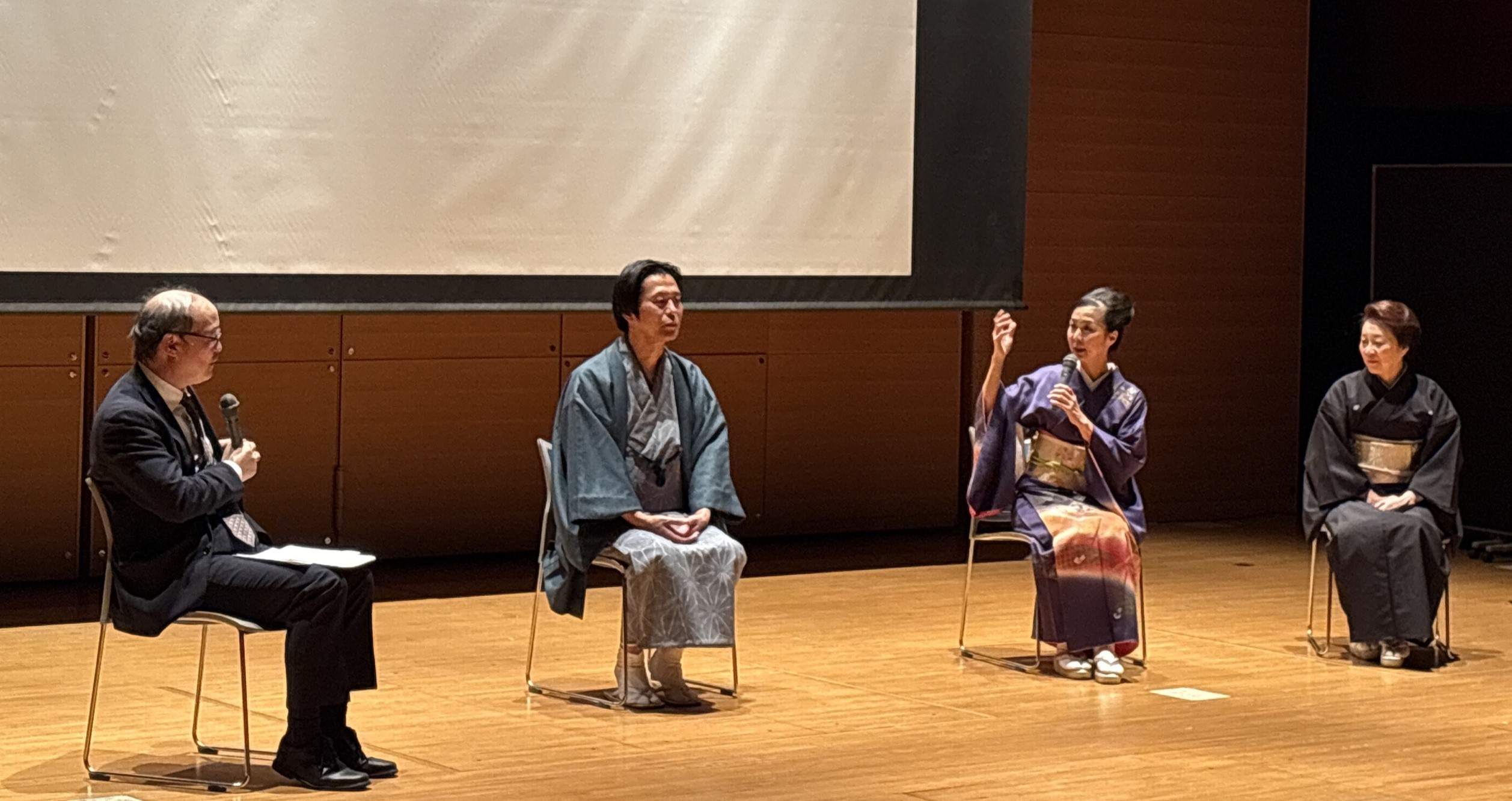
As the culmination of 2 years of activities, the team worked to “reconstruct” a biwa film screening for the second time since 2023. This year’s screening was accompanied by satsuma biwa player Kawashima Nobuko, film narrator Kataoka Ichiro, and Japanese traditional percussionist Katada Kisayo. The event featured a film from the Kobe Planet Film Archive’s collection, Ishidomaru, Tsukushi no tachikaze (1925), which was digitized in the last academic year with the cooperation of the Yanai Initiative, and a biwa script from the National Film Archive of Japan(NFAJ)’s collection. In the first part of the symposium, collaborative researchers Kamiya Makiko, Shirai Fumito, and Shibata Kotaro presented research on the film’s historical background, silent film practices in Germany, and the genealogy of biwa films. In the second part of the symposium, a multifaceted discussion was held, with commentary by museum director Kodama Ryuichi and talks with the performers.
To further disseminate the team’s findings on film screening materials, Shibata gave an oral presentation at the 51st National Convention of the Japan Society of Image Arts and Sciences (June 1, 2025, Kobe University) about the film supply system in the Taisho period and movie theaters in Sapporo. Principal researcher Okada Hidenori played a leading role in creating a program for the preservation and utilization of film-related materials at the 2026 National Archive Summit on Film-Related Material (January 23, 2026 / online) organized by the NFAJ (AY2025 Model Project for the Development of Core Archival Hubs). Okada also provided daily commentary on the films featured in the “Japanese Silent Cinema” special screening held in France by the Jérôme Seydoux-Pathé Foundation from October 21-25, 2025. In October 2025, Kamiya published a book entitled War, Occupation, and Japanese Cinema: Reframing the “Darkness” of History (Seidosha), which includes some of the results of this research.
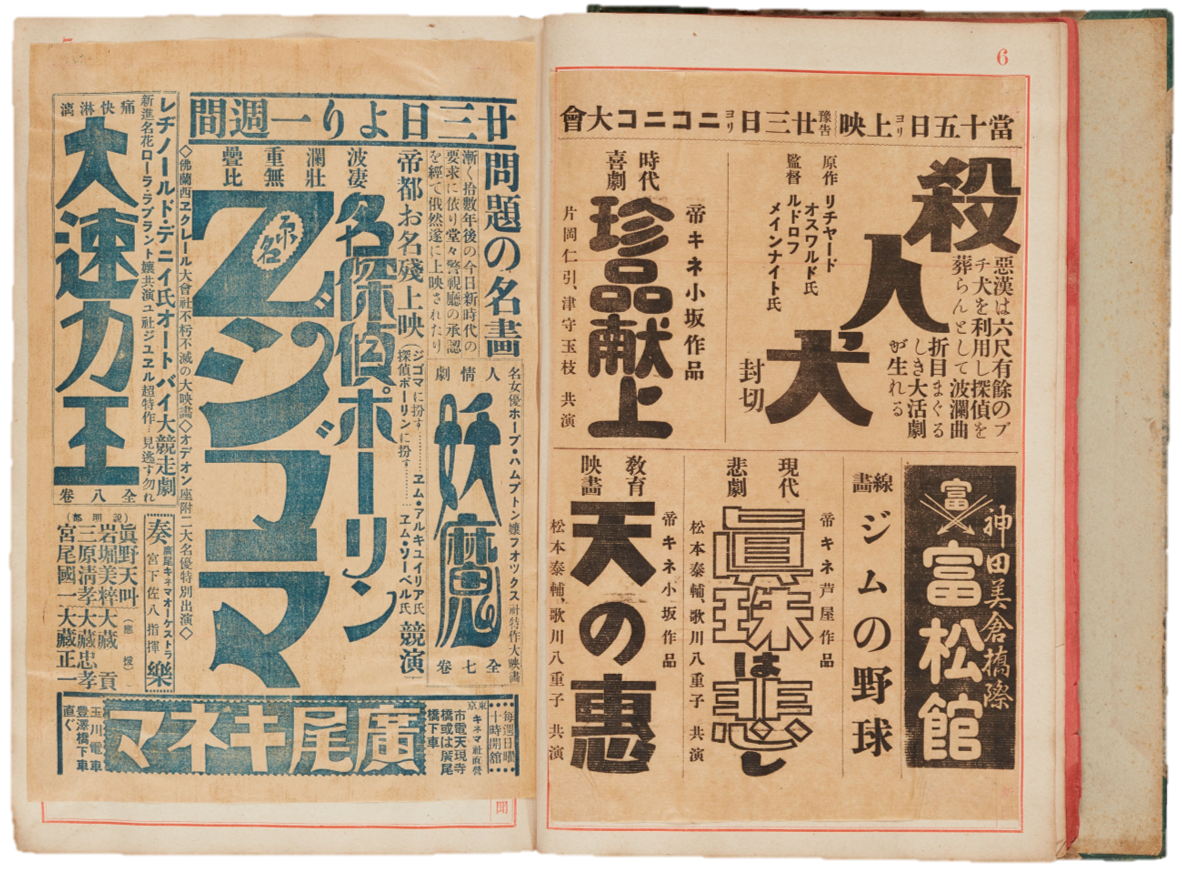
(L)From the Komada Koyo material[16758-1_009]
(R)Post-screening discussion at the “Rivising the Sounds of Biwa Film 2026” screening and symposium(January 29, 2026)
From left: Prof. Kodama Ryuichi, Kataoka Ichiro, Kawashima Nobuko, Katada Kisayo.
Principal Research 4
Research on the Systematic Organization of Materials Related to the Tiny Alice
Principal Researcher
Kim Yun Jeong (Full-time Lecturer, Sugiyama Jogakuen University)
Collaborative Researchers
Okada Fukiko (Full-time Lecturer, Kyoto University of the Arts)
Research Objectives
This study will organize and catalog extensive materials—documents, posters, pamphlets, flyers, photographs, video records, and reviews—related to Tiny Alice (a little theater in Shinjuku, Tokyo; 1983-2015) to lay the foundation for the preservation and utilization of these materials. In particular, we aim to investigate and organize materials related to the ALICE FESTIVAL, and based on the materials, clarify the historical development and cultural significance of the festival, as well as its position in the Japan-Korea theatrical exchange, which has been increasingly active since the 2000s. Through this process, we will examine the role of the Tiny Alice as a center for experimental practices in theater, music, dance, and film, and develop academic resources that will contribute to basic research on the Japanese little theater movement and the history of cross-border cultural exchange.
Summary of Research
This academic year, as the earliest stage in the project, we began the initial organization of materials related to the Tiny Alice donated to the Theatre Museum, especially those related to the ALICE FESTIVAL. Specifically, festival-related materials (such as flyers, programs, and printed materials with information on performances and projects) were identified among scattered materials, arranged in chronological order, and categorized based on information, such as the year and edition of the festival, to obtain an overall perspective of the groups of materials. This enabled us to understand the domains (theater, music, dance, film, etc.) that have been continually involved in the festival as well as the pattern of repetition and renewal of projects through the formation of groups of materials, and gain a perspective for future organization and study.
Furthermore, we held repeated meetings to understand the details of the materials, discussing basic information on the history of the festival, trends in participating groups, forms of performance, and frameworks for exchange, while researching specific names (such as participating groups, works, venues, and co-sponsors/collaborators) that appear in the materials. We also cross-checked continuity across related projects and series to improve description accuracy in future cataloging.
Regarding items for which information was unclear in the materials and relationships between projects, we conducted interviews with collaborator Kim Seil (director/actor) to confirm the positioning of individual materials. Although many of the donated materials were similar in terms of the appearance of the printed copies, through interviews, we were able to refer to the actual management and production practices of the time and find clues to distinguish between multiple materials related to the same project, derivative projects, peripheral events, etc. These steps are essential for arranging materials and establishing organizational units (groups of materials) with background information.
Furthermore, for audiovisual materials, we prioritized items for digitization with collaborators and devised a plan for future digitization and preservation (to be carried out by the Theatre Museum). Because recorded media vary widely and face deterioration and playback restrictions, we established the order of priority based on rarity of contents, importance in the history of the festival, and possibility of matching with other materials. In addition, we made progress in organizing the flyer data chronologically, in preparation for future data registration.
Although the above findings have not led to the completion of the final catalog or the publication of analysis results, they are significant for two reasons: First, they led to the establishment of an organizational framework based on a chronological axis for materials related to the ALICE FESTIVAL, which are at the core of the Tiny Alice collection; additionally, they clarified the characteristics of groups of materials and the challenges involved in research. This study was supported by JSPS Grant-in-Aid for Scientific Research 23K00226. Materials and interviews confirmed the festival’s management practices and evidence of Japan Korea theatrical exchange, providing a basis for future cataloging and analysis.
In the future, we will continue cataloging and data registration; as digitization progresses, we will systematize cross-references and publish the collection for research and educational use.
Principal Research 5
Survey of Maeda Naoki Materials
Principal Researcher
Saito Keiko (Associate Professor, Department of Japanese History and Culture, School of Japanese Studies, Aichi Prefectural University)
Collaborative Researchers
Ito Masaru (Associate Professor, Meiji University)
Moriya Risa(Program Specific Associate Professor, Institute for Research in Humanities, Kyoto University)
Kondo Tsugumi(Assistant Professor, Waseda University Theatre Museum, Waseda University)
Research Objectives
In February 2024, Katori Takao, the heir of former Imperial Japanese Navy serviceman Maeda Naoki (1896-1964), donated a collection of Maeda’s materials to the Theatre Museum. From 1932 to 1934, Maeda was appointed assistant to the military attaché at the Imperial Japanese Embassy in Moscow, Soviet Union. At the outbreak of the Pacific War, he became a military attaché stationed in Harbin, and after the end of the war in Manchuria, he was interned in the Soviet Union and demobilized in 1953. A major part of the donated materials consists of theatre-related materials that Maeda collected locally during his time in Moscow. This study aims to achieve the following two objectives based on a survey of materials. The first objective is to closely examine the rare records of Japanese individuals who actually experienced prewar Soviet performing arts to clarify how the Japanese of that time interpreted Soviet arts as a cross-cultural experience. The second objective is to understand the origin of the performing arts that internees experienced in Siberian prison camps, which had a significant impact on postwar Japanese culture. In internment camps, the practice of performing arts was encouraged as part of Soviet socialist propaganda. Maeda witnessed performances that lay the foundation for the Soviet performing arts practiced in the camps.
Summary of Research
Among the donated materials, the Theatre Museum received 255 stage photographs and bromides of Soviet theatre, ballet and opera, 36 Russian-language books, one theater-going notes from a period of residence in Moscow, one postcard written in Japanese, and a set of seven preliminary drawings for a Kabuki program. Additionally, 70 other books were transferred to the Waseda University Library, 40 of which will be housed there after the necessary selection process. Most of the other materials in the Maeda Naoki Collection are housed at the Yamato Museum (Kure Maritime Museum) and the Kobe Planet Film Archive, while some remain in the possession of Maeda’s relatives. A comprehensive examination of these materials may open up prospects for research in many fields, including the history of Russian theatre, intelligence activities by the Imperial Japanese Navy, the use of art in wartime propaganda, and the experiences of internees in Siberia.
This project began in April 2025. In the first year, we began our activities by interviewing Maeda Naoki’s relatives; we then transcribed his theater-going notes and cataloged the performances he attended; finally, we commissioned the writing of a paper to clarify Maeda’s personal history.
Katori Takao and Maeda’s relative, Kato Junko, participated in the interviews. Five students from the Aichi Prefectural University Undergraduate School of Japanese Studies assisted in the transcription of the theater-going notes. Graduate students from the Drama and Theatre Arts Program of the Meiji University Graduate School of Arts and Letters assisted in the cataloging of the performances (in both Japanese and Russian). Individuals who experienced performing arts in the Soviet Union and recorded their impressions before Maeda include Narumi Kanzo, Osanai Kaoru, and Sonoike Kinnaru. The distinctiveness of Maeda’s records lies in his exceptionally observant eye for staging and the meticulousness of his sketches of stage sets, which one would not immediately expect from omit “the common image of” a military serviceman. The style of writing suggests that Maeda intended these records as memoranda to be expanded on later on.
As a result of the interviews, we learned about the findings of several researchers who have been cooperating with the relatives at their request. Some of their works are still unpublished. Among them, we asked Okita Kyosuke, a doctoral student at Nihon University’s Graduate School of Literature and Social Sciences who conducted in-depth research on Maeda’s activities during his years in the navy, to contribute to the bulletin of the Theatre Museum (to be published in Studies in Dramatic Art No. 49). His study reveals that it was Maeda’s official assigned duties that made his extensive collection activities possible.
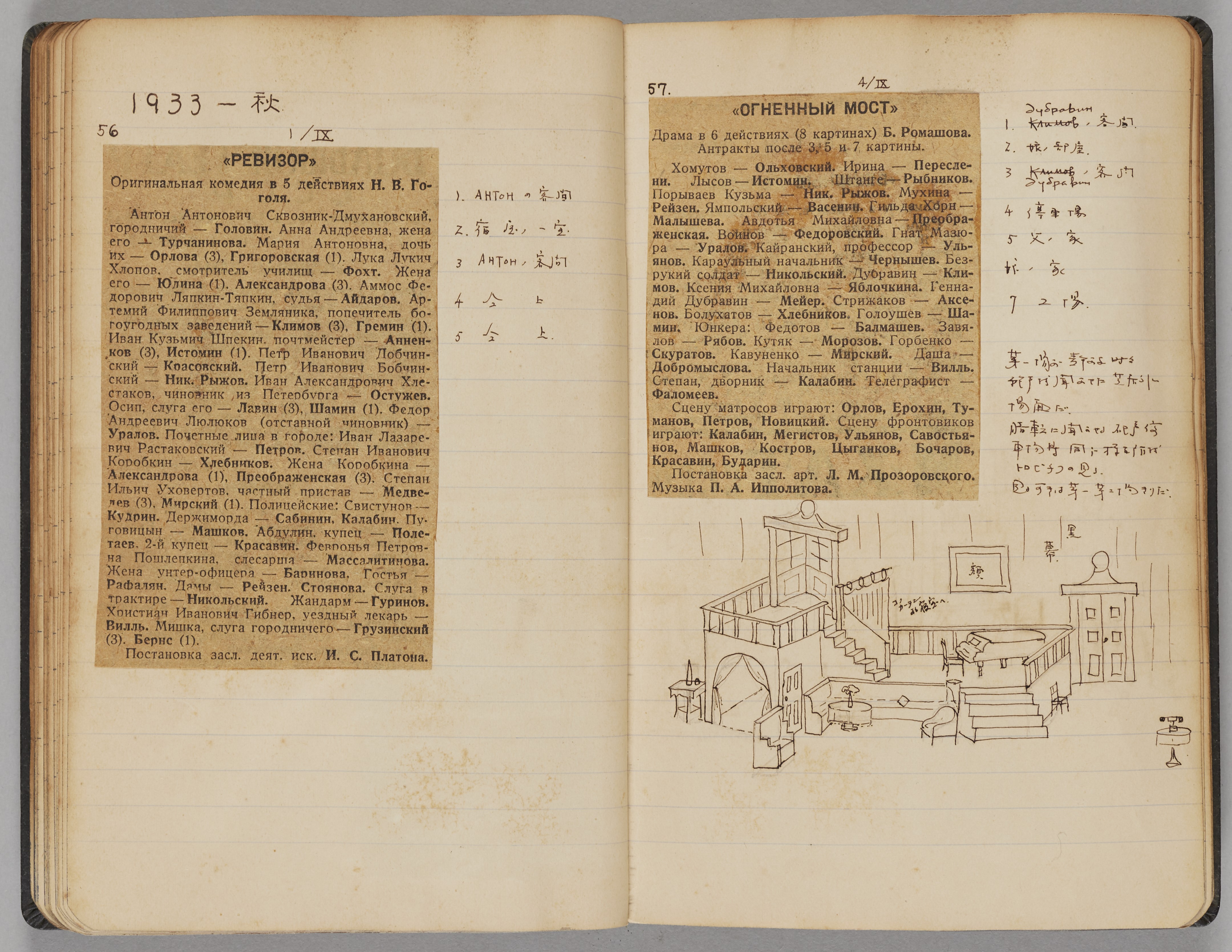
Naoki Maeda’s theater-going notes (September 4, 1933)[61262]
Maly theatre “The Fire Bridge” written by Boris Romashov and staged by Lev Prozorovsky
Selected Research 1
Basic research on the Okamoto Kido Collection
Principal Researcher
Yasuko Yokoyama (Professor, Department of Advances Sciences, Faculty of Science and Engineering, Hosei University)
Collaborative Researchers
Higashi Masao (Literary critic, anthologist)
Komatsu Shoko (Professor, Faculty of Letters, Arts, and Sciences, Waseda University)
Suzuki Yusaku (Specially-appointed assistant professor at the Center for Modern Kagoshima Studies, Faculty of Law, Economics and Humanities, Kagoshima University)
Hara Tatsukichi (Curator, Setagaya Literary Museum)
Matsuda Shohei (Fixed-term assistant professor, Faculty of Letters, Otani University)
Kensuke Wakisaka (Gakushuin High School)
Katsukura Ai (Nagoya City Higashigaoka Elementary School)
Research Objectives
The purpose of this study is to conduct basic research and analysis of materials in the Okamoto Kido Collection. It was 150th birth anniversary of Okamoto Kido (1872-1939) in the year 2022, who left a significant mark in the fields of theater and literature. Kido was an active writer in a variety of fields, including plays, drama reviews, novels, essays, and translations. In recent years, he has attracted attention not only in the research fields of modern drama and modern literature but also in diverse fields such as the study of ghosts, ghost stories, and yokai. This study focuses on Okamoto’s unpublished and untranscribed diaries and aims to digitize and transcribe them. We believe that these materials are first-rate resources for understanding the later life of the writer Okamoto Kido and that reprinting them and making them widely available will provide.
Summary of Research
The Theatre Museum houses Okamoto Kido’s handwritten diaries from July 1923 to December 1938. Among these, the diaries from 1931 to 1938 had not yet been published or transcribed. The team continued the transcription of the diaries that began last year, and in July 2025, published the January-December 1931 and January-December 1932 diaries.
In these diaries, Kido has reached the age of 60. In addition to his vigorous writing activities, he describes his efforts in training his successors and editing the magazine Butai (Stage). Kido’s diaries provide a matter of-fact account of his daily life as a city dweller amid various major social events, such as the Mukden Incident and the development and expansion of Tokyo City, and serve as valuable materials to shed light on history based on personal records.
To commemorate the diaries’ publication, we held the event “The Daily Life of Okamoto Kido: Symposium Commemorating the Publication of Okamoto Kido’s Diaries from 1931 and 1932” (August 23, 2025, Waseda University Building 3, Room 401).
The symposium featured four research papers: “Okamoto Kido in 1931 and 1932: Kido Zenshu and Dokugin” by Hara Tatsukichi; “Okamoto Kido as a Leader: Futaba Kai and Butai Magazine” by Akai Kimi; “Okamoto Kido and the Reorganization of the Detective Story Genre” by Matsuda Shohei; and “How the Popular Gaze Relativizes History: Okamoto Kido’s Saigoboshi” by Suzuki Yusaku. Additionally, Higashi Masao, Yokoyama Yasuko, and Komatsu Shoko held a tripartite discussion examining the appeal and new significance of Kido’s works.
Nearly 100 people participated in the in-person and online sessions and a variety of opinions were exchanged during the Q&A. Novelist Kyogoku Natsuhiko also made interesting comments about Okamoto Kido and his detective novels, confirming that Kido and his works are capable of attracting a wide range of interest.
This academic year, the team also plans to release transcriptions of the January-December 1933 and January-December 1934 diaries. At that time, Kido had moved from his usual residence in Motozono-cho, Kojimachi Ward to a separate house in Kamimeguro, and many of the entries vividly portray life in the suburbs of Tokyo.
The transcribed diaries are already available on the website of the Collaborative Research Center for Theatre and Film Arts and will be updated in the future. It is our hope that, once this information is widely available to the public, it will be utilized by many people.
The transcription and publication of four years of Kido’s diaries over the course of just two years can be considered a significant achievement. However, the remaining four years of diaries have yet to be transcribed. We believe that there is a need to transcribe these diaries, which provide a record of Kido’s final years.
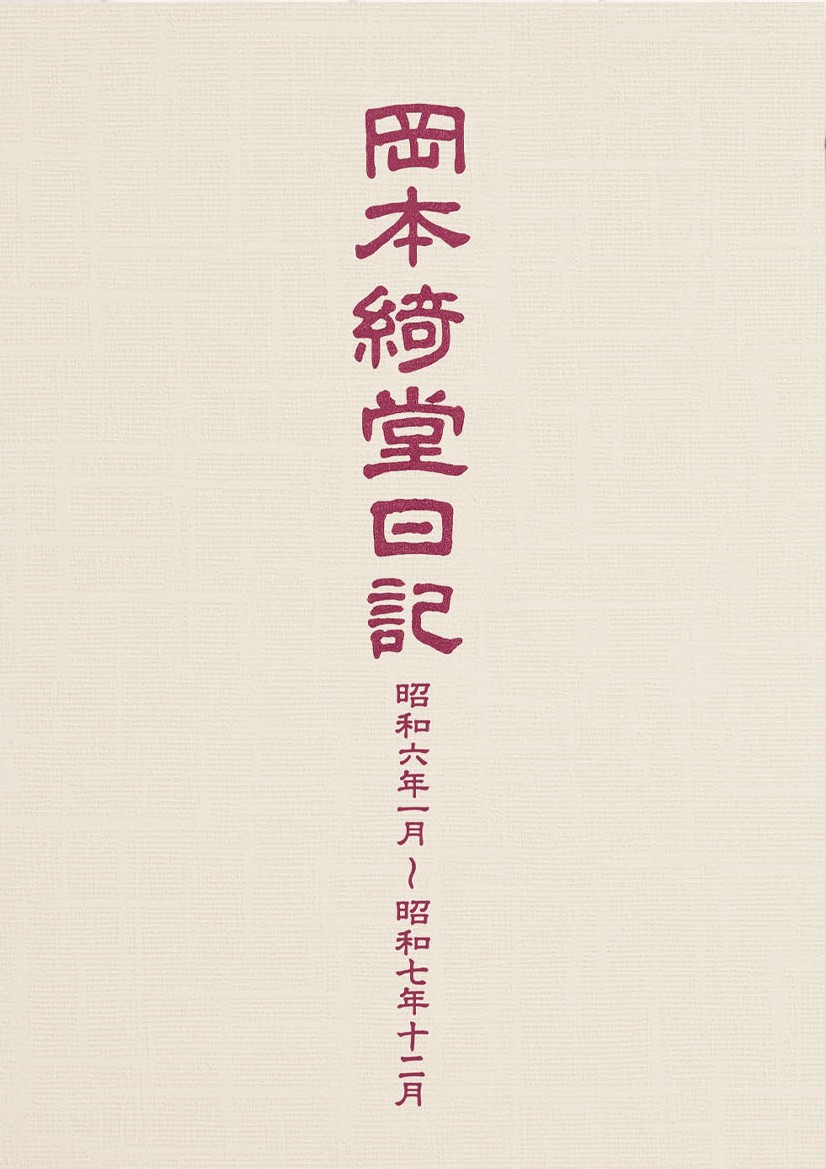
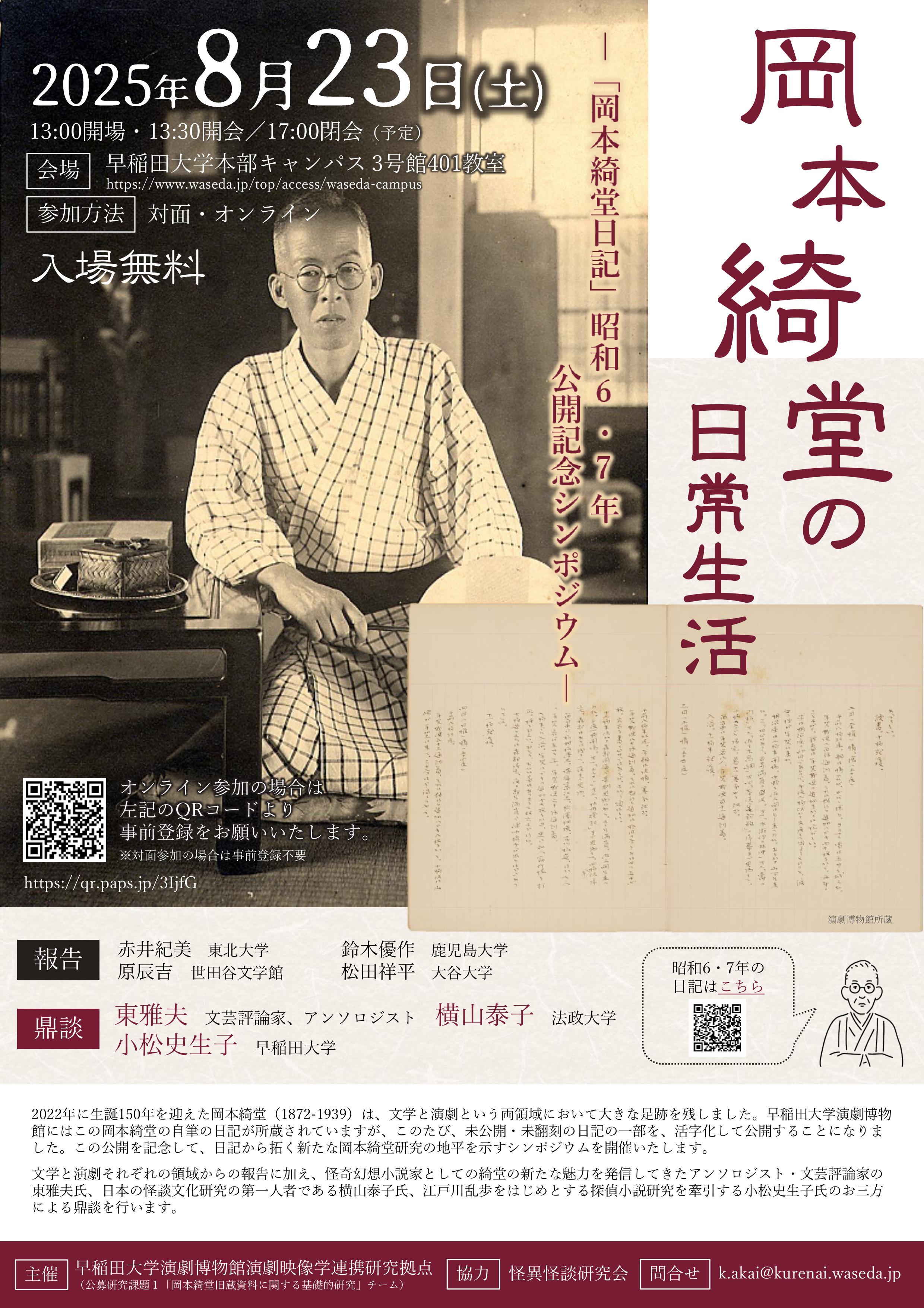
(L)Image1 : Cover of the 1931-1932 diaries transcribed and published
(R)Image2 : Flyer for the symposium
Selected Research 2
Literary Circles of the Mid-Edo Period, Through Diaries of kabuki Actors
Principal Researcher
Björk, Tove Johanna (Professor, Saitama University Graduate School of Humanities and Social Sciences)
Collaborative Researchers
Inaba Yusuke (Associate Professor, Wako University Faculty of Liberal Arts)
Hioki Takayuki(Associate Professor, School of Information and Communication, Meiji University)
Research Objectives
Based on the diary of Kabuki actor Ichikawa Danjuro II, this study aims to (1) examine the composition process of the diary and its authenticity as an historical material; and (2) investigate the literary circles of the mid-Edo period, focusing on Kabuki performers. The Hakuen Diary, along with another diary entitled Kakibyoshi (Persimmon Cover), was copied by the attending physician of the kyoka parody poet Shikatsubeno Magao and his son. It constitutes an important record of the daily lives of Kabuki actors in the mid-Edo period and the literary circles that surrounded them. With the diary as a starting point, this study aims to elucidate the environment surrounding Kabuki actors during the Kyoho era and their connections to haikai poets and other literati.
Summary of Research
This academic year, first, we continued the annotation and commentary of the diaries. Second, we examined amateur’ imitations of Kabuki performances in the Three Great Festivals of Edo recorded in Danjuro II’s and Nakamura Nakazo I’s diaries, as well as an ukiyo-e series depicting parades during the Gion Festival in Kyoto. Third, we analyzed Enyu Nikki (Diary of Banquets and Amusements) by Yanagisawa Nobutoki, the second lord of the Yamato Koriyama domain and a regular Kabuki performer, to examine the realities of Kabuki performances in feudal residences. Fourth, we investigated 42 publications presenting the origins of Kabuki theatres and Kabuki acting published from the late 18th to late 19th century, considering how the world of Kabuki chose to stress its respecatibility in the government approved business licences and long family lineages.
We continued to annotate the diaries of Ichikawa Danjuro II, publishing Part 10 and Part 11 in (Saitama University Faculty of Liberal Arts Review) Vol. 61, No. 1, & 2. These sections of the diary cover the 25th of the 6th month to the 7th days of the 7th month of Kyoho 19 (1734). During this period, Danjuro II made pilgrimages to temples and shrines around his villa in Meguro but also attended an emergency meeting of leaders in the Kabuki world following the death of Bando Matakuro II. These entries discuss the closing of the Morita-za theater, an extremely important turning point in the history of Kabuki, and the specific circumstances that led to the development of hikae yagura (substitute theaters) in the Kabuki world.
The second result was presented at an International Federation for Theatre Research at the University of Cologne, Germany (June 10, 2025), as “The Walk of Fame – Women of the Licensed Quarters Dressing like Kabuki Actors in Early Modern Festival Parades.” Similar findings were presented by collaborative researcher Hioki at the Institute for Performing Arts, hosted by Meiji University, under the title “Methods of Kabuki Reconstruction in the Early Modern Period.” The main findings were that the Kabuki characters reconstructed at the festivals chose symbolic elements to express the characters rather than downright imitation.
The third research result has been summarized in a paper entitled “Kabuki Performances and Okyogenshi Performers at the Yanagisawa Nobutoki Residence as Seen in Enyu Nikki,” which will be published in the journal History of the Performing Arts. This paper reveals that when Yanagisawa Nobutoki prepared for Kabuki performances at his residence, he first chose dance scenes that were popular in theaters at the time, and then composed a script by combining several joruri books. It was also noted that the residence Okyogenshi have been a relative of Nakamura Nakazo I.
Fourth, principal researcher Björk collected and analyzed commercial publications describing the origin of Kabuki theatres and the lineages of important actors’s houses, establishing early modern sense of ‘tradition’ as a business practice, the results published in ‘Traditional’ Kabuki– from Business Practice to National Policy” Critical Stages/Scènes critiques, Dec 2025, Issue 23.
Above are the main results of this research in AY2025. In the future, to shed more light on the realities of literary and artistic circles in the Edo period, we plan to further analyze the specific relationships between theatre makers, fans, writers, and haikai poets in Edo.
Selected Research 3
Empirical Research on Regional Theater Under the GHQ (SCAP) Occupation: Focusing on the Kyushu Area
Principal Researcher
Ogawa Chikashi (Professor, Faculty of Childhood Education, Yokohama Soei University)
Collaborative Researchers
Sugawa Wataru (Associate Professor, Faculty of Humanities, Fukuoka Jo Gakuin University)
Hatanaka Sayuri (Part-time Lecturer, Osaka University)
Research Objectives
The objective of this study is to clarify the characteristics of the theater produced immediately after World War II in the Kyushu area. This is accomplished through an analysis of the Dizer Collection (scripts from Kyushu-area theatrical productions censored by the SCAP [GHQ]).
Summary of Research
This academic year, 13 scripts from the Dizer Collection were digitized. The results of this research were presented at the 186th meeting of the Institute of 20th Century Media held in May 2025. In addition, an article will be published in the Institute’s journal, Intelligence.
The research results of each of the collaborative researchers are outlined below.
Regarding amateur theater, we conducted a survey of scripts submitted by the Reimeiza theater in Hiroshima Prefecture. The collection includes many scripts submitted by the Reimeiza theater, led by evacuee theater artist Takenaka Sokichi. An examination of these scripts revealed aspects of the theatrical culture introduced to the region by theater artists who had been active before the war. We also clarified the actual status of submissions for censorship related to theatrical activities in the region.
Regarding theater companies in Kumamoto, we examined the expressive differences between shojo kageki and shingeki in postwar Kumamoto based on research on conducted in the academic year before last on Gekidan Orionza, and research on the works of the Bungeiza Theater Company and Shimokawa Enji conducted in the last academic year. Specifically, drawing insights from the history of works that were not allowed to be performed, we discovered that Bungeiza’s and Shimokawa’s plays thematized the contradictions and conflicts of postwar society, such as demobilized soldiers, agrarian reform, and the crisis of values, and viewed postwar reform from a critical perspective. Meanwhile, we confirmed that Orionza was staging plays that were entertaining and topical in nature, actively addressing various elements from that time, such as the new Constitution, the rationing system, and postwar democracy. Through this comparison, we demonstrated that even in the same time and place, differences in genre had a significant impact on the reception and representation of postwar society. In addition, Bungeiza’s repertoire included plays based on existing literary works, such as Tokutomi Roka’s Kaijin (Ashes) and Miyazawa Kenji’s works. In the future, we hope to explore how Shimokawa adapted and reconstructed these works, transforming them into unique plays.
Regarding popular theater genres, we examined their content focusing on the Higuchi Jiro Theater Company, the Nanjo Takashi Theater Company, the Mikawaya Momotaro Theater Company, the Emi Saburo Theater Company, and the Okawa Ryunosuke Theater Company, which were based in Kyushu and were popular from the prewar to the occupation period. It is clear from our research to date that popular theater at the time was rich in variety. Many plays included standardized themes, such as a the wandering life of a gambler or revenge. However, there were also plays about demobilized soldiers, which were based on current events, romance plays about sailors, and plays that featured the occupation forces (although many were not allowed to be performed due to censorship). This indicates that the popular theater of the time did not stick to old-fashioned themes but continued to seek out stories that would entertain the audience.
We also reviewed the actual scripts of setsugeki (plays accompanied by rokyoku narrative singing), which are rarely performed today, and a small number of rensageki (plays alternating live performances with film screenings). Such scripts will be a valuable resource in the study of past forms of performance. The collection includes numerous scripts in the popular theater genre. Up to this academic year, we have been able to examine only about one-fifth of these scripts. We plan to steadily continue our survey of the materials in the future.
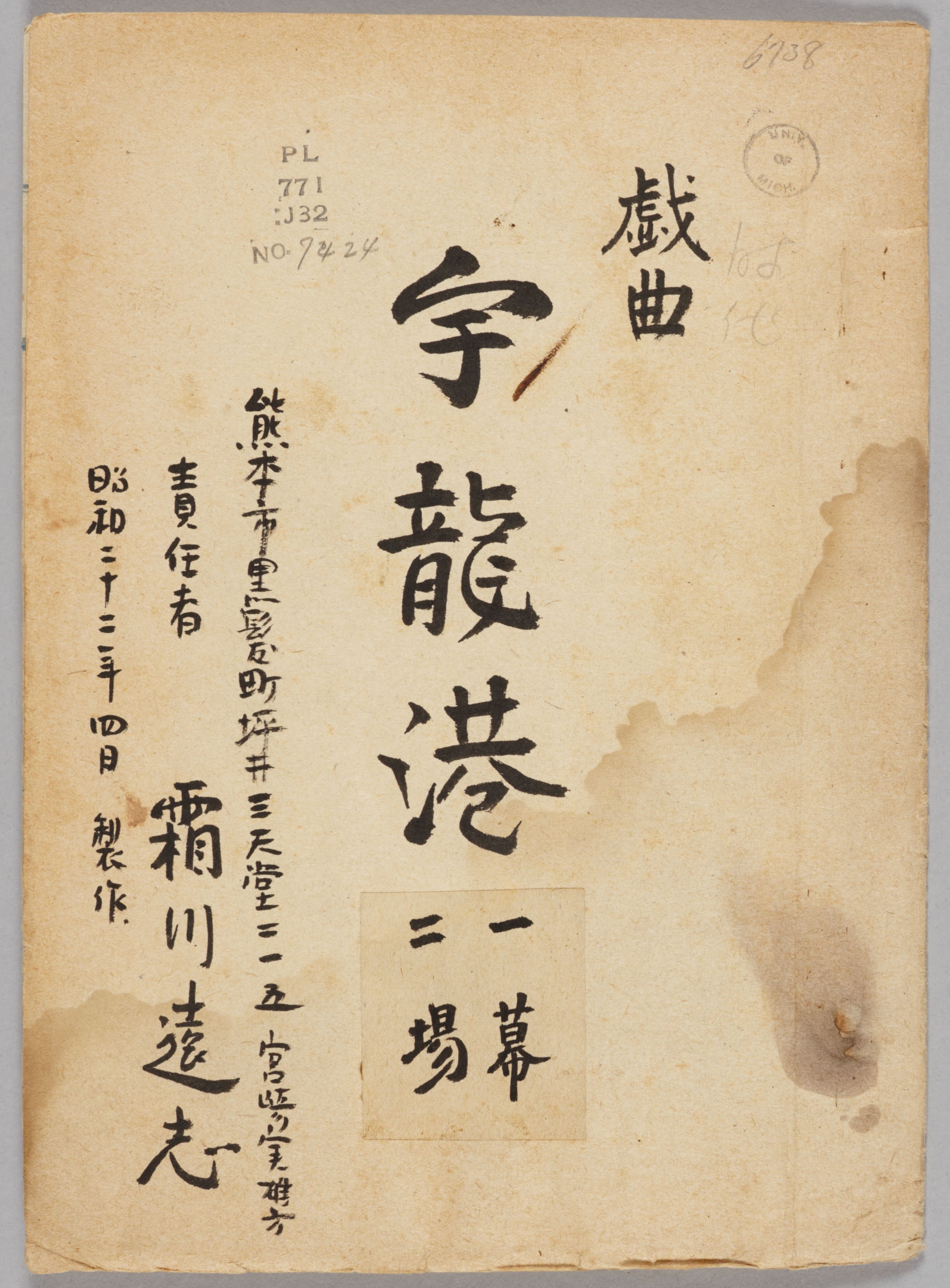
“Uryuko”[GHQ06738]By Shimokawa Enji. Produced in April 1947
The subtitle is “On the Theme of Renunciation of War.” This work was later included in High School Theater Scripts,
Vol.3 (Hobunkan,1956), edited by the Japan Theatre Arts Association, under the revised title “A Defeat.”
Selected Research 4
Research on Kodan Materials in the Tanabe Koji Collection
Principal Researcher
Imaoka Kentaro (Professor, College of Art and Design, Musashino Art University)
Collaborative Researchers
Sato Katsura (Professor, College of Literature, Aoyama Gakuin University)
Sato Yukiko (Professor, Faculty of Letters, The University of Tokyo)
Takamatsu Hisao (Professor, Faculty of Letters, Arts and Sciences, Waseda University)
Takiguchi Masahito (Lecturer, Keisen University)
Research Objectives
The late Tanabe Koji was a longtime editor at Shinchosha. While working in that role, he conducted research on kodan storytelling and edited and published the magazine kodan Kenkyu (Kodan Research) to introduce materials and publish his research findings. The purpose of this study is to elucidate the full extent of the materials related to kodan in the Tanabe Collection which was donated to the Waseda University Theatre Museum. Among the wide range of kodan related materials collected by Tanabe, the most unique are the audio recordings of kodan broadcast on the radio from the 1960s to 2000s, of interviews with kodan performers themselves, and of kodan meetings hosted by Tanabe. This study will begin with a full investigation and digitization of the audio materials, followed by cataloging of the recorded performances.
Through our work on this project, we will shed light on the characteristics of kodan performances handed down in the Showa and Heisei periods and the characteristics of kodan performers themselves (such as the repertoire handed down to them and their artistic styles). Simultaneously, we will proceed with the identification of the performances in the digitized audio materials. While conducting this work, we will also examine the influence of literature in the early modern and modern periods, the influence of rakugo and other forms of vaudeville theater, and the mutual influence between these art forms and Kabuki performances.
Summary of Research
In AY2025, continuing on from the last academic year, we focused on the digitization of audio materials and cataloging of performances from the Tanabe Collection. With the help of research collaborators, we digitized the performances, identified them, cataloged them by performer, and analyzed the oral performance trends of kodan during the Showa and Heisei periods. At this stage, about three quarters of the 887 items in the provisional catalog have been identified and digitized. This has made future surveys and research on these audio sources possible without worrying about degradation of sound quality. However, about one quarter of audio sources have not been identified and digitized. These tasks will be addressed from the next academic year. Meanwhile, we are still looking for ways to publish the digitized materials in a limited capacity for research purposes, although we are not yet at a point where the materials can be made fully available to the public due to copyright issues. This will also be a task for the next academic year and beyond.
Through this work, we also discovered an audio source for Hanano, a novel by Setouchi Jakucho (Harumi) about Kanda Shori II. This finding reaffirmed the importance of kodan in the study of literature in aspects other than performance.
Meanwhile, the identification and matching of the performances themselves, which is conducted in parallel with the above, is difficult. This is partly because many of the materials are parts of full-length performances, and partly because it is difficult to create subheadings and correctly position them within full-length performances. As our work progressed, it became necessary to compare the Tanabe materials with those of Osaka Metropolitan University, which holds a collection of shorthand materials formerly belonging to Yoshizawa Hideaki and is preparing to organize and publish these materials. In March 2025, principal researcher Imaoka and collaborator Kanno visited Osaka Metropolitan University to compare the audio recordings in the Tanabe Collection with these shorthand materials.
We believe that the findings of this research, based on actual oral performances, will provide new perspectives for the study of early modern and modern literature.
Additionally, to disseminate some of the results of these studies, a public research meeting entitled “Literary Studies and kodan” was held on January 27, 2026, and a symposium entitled “The Expansion of kodan as Seen from Materials in the Tanabe Koji Collection,” which included a demonstration of kodan, was held on February 7, 2026.
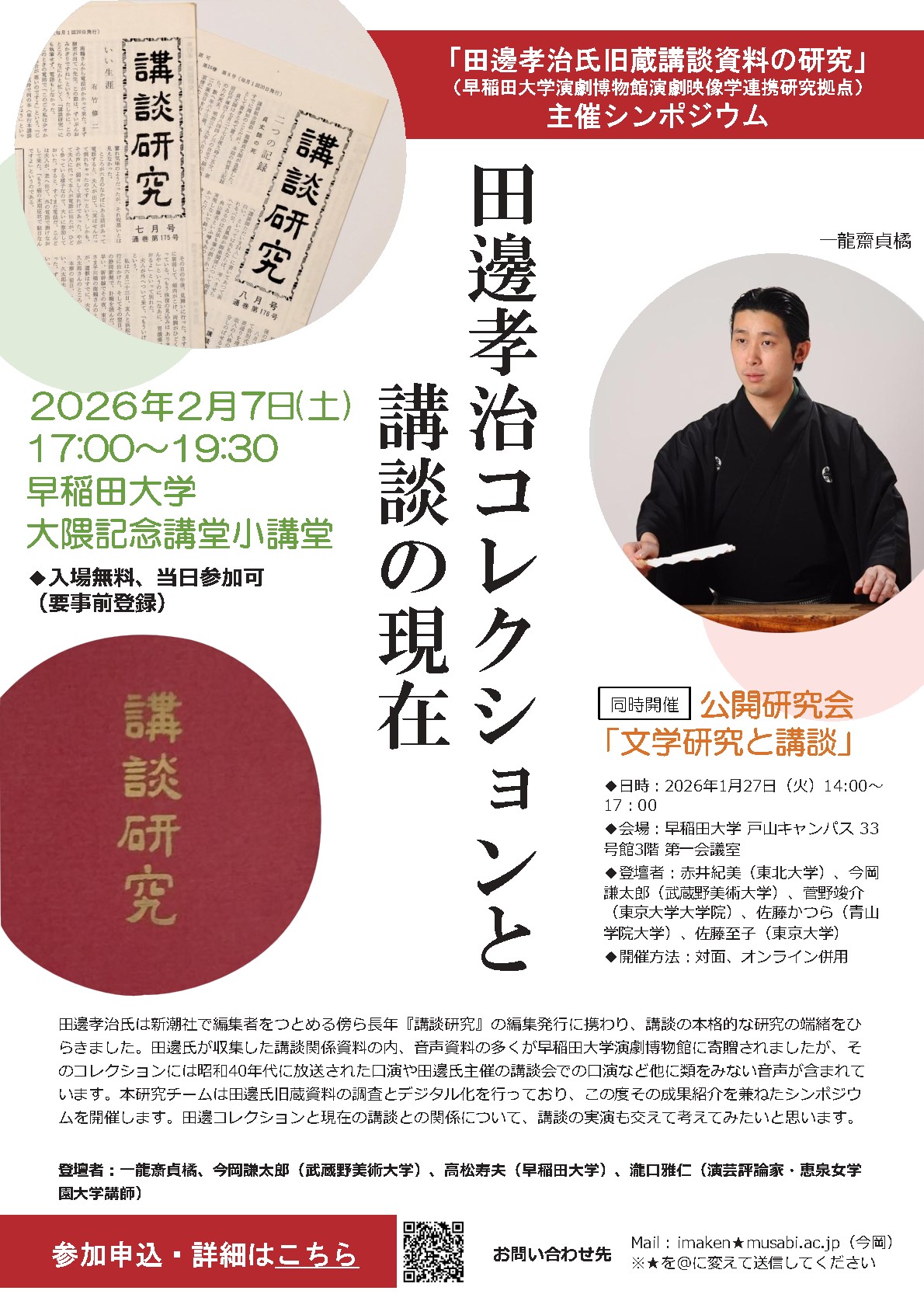
Event flyer for the public research meeting and symposium
Selected Research 5
Overview Survey of Print Inventory Left Behind by Sakagawaya, the Original Publisher of Tokiwazu-bushi
Principal Researcher
Takeuchi Yuuichi (Professor, Research Institute for Japanese Traditional Music, Kyoto City University of Arts)
Collaborative Researchers
Suzuki Eiichi (Adjunct Researcher, Theatre Museum, Waseda University)
Tsuneoka Ryo (Director, Tokiwazu Association, Successor to Tokiwazu Iemoto)
Abe Satomi (Part-time Lecturer, Musashino Academia Musicae)
Maeshima Miho (Associate Professor, Kunitachi College of Music)
Shigefuji Gyo (Lecturer, Waseda University Extension Center)
Konishi Shiho (Collaborative Researcher, Kyoto City University of Arts)
Research Objectives
In 1860, near the end of the Edo period, Sakagawaya inherited Tokiwazu woodblock prints from their original printer, Igaya. Sakagawaya continued to reprint these works as well as publish new works through the Showa period, printing original copies (practice books) from woodcuts up through 1987 or so. The “print stock”(stock of printed originals and unfinished copies, 47 boxes in all, numbering several tens of thousands of items) formerly owned by this publisher and donated to the Theatre Museum constitutes the “materials related to the original Tokiwazu-bushi in the Sakagawaya Collection” that are the subject of this study.
To reliably organize, preserve, digitize, and publish this unique group of materials, our primary objective for this academic year was to conduct a bibliographic survey and create a basic catalog of the entire group of materials. In the future, a more in-depth investigation will shed light on the actual activities of Sakagawaya, which was arguably the last printer of its kind in Japan.
Summary of Research
(1) Survey of current condition of material storage boxesWe confirmed that the box numbers (primary numbers) assigned after the collection was acquired by the Theatre Museum go from 1 to 35. However, there are two missing numbers. In addition, 14 boxes have been given sub-numbers. The sub-numbers were apparently assigned when materials in old boxes that had been damaged were divided into several new, smaller boxes. The total number of boxes is 47.
(2) Bibliographical survey, assignment of package numbers (secondary numbers) and cataloging of each package in the boxes
Next, we surveyed the status of the materials stored in all the boxes. Although there are signs of damaged strings being replaced, and some materials being reclassified during a preliminary survey in 1995, the packaging from the time of Sakagawaya’s closing is generally preserved as is.
The majority of the materials are print stocks of Tokiwazu practice books. A summary of the survey and some photos were published in the last academic year’s Newsletter. In addition, we confirmed the existence of a print stock of pocket-sized practice books, a print stock of daisen (title slips), a collection of program prints, and material fragments and memoranda related to editing, printing, sales, and more. Notably, the usumono shohon (thin scripts) of the late Edo period and the Kabuki banzuke (Kabuki theater programs) of the Meiji period, which had been confirmed in the 1995 preliminary survey, were not included in the survey materials.
To enhance the preservation of the materials and facilitate cataloging and future digitization, all materials were assigned a secondary number and cataloged by original package or arbitrary grouping. The secondary numbers are approximately 120 in total.
(3) Photography and digitization of program prints and other materials
The collection includes about 150 types of program prints and other Tokiwazu-related materials, most of which are single-sheet prints. Unfinished copies and notes are included as well. The materials are believed to include a mix of print stock printed by Sakagawaya on consignment and prints delivered to Sakagawaya by related parties. There are also many rare materials that were not available in the biographical survey of performers conducted by the principal researcher (List of Tokiwazu-bushi Performers in eight volumes, published by the Tokiwazu-bushi Preservation Society, a project subsidized by the Agency for Cultural Affairs). We intend to conduct an overview survey and create a catalog of the programs in the next one or two academic years.
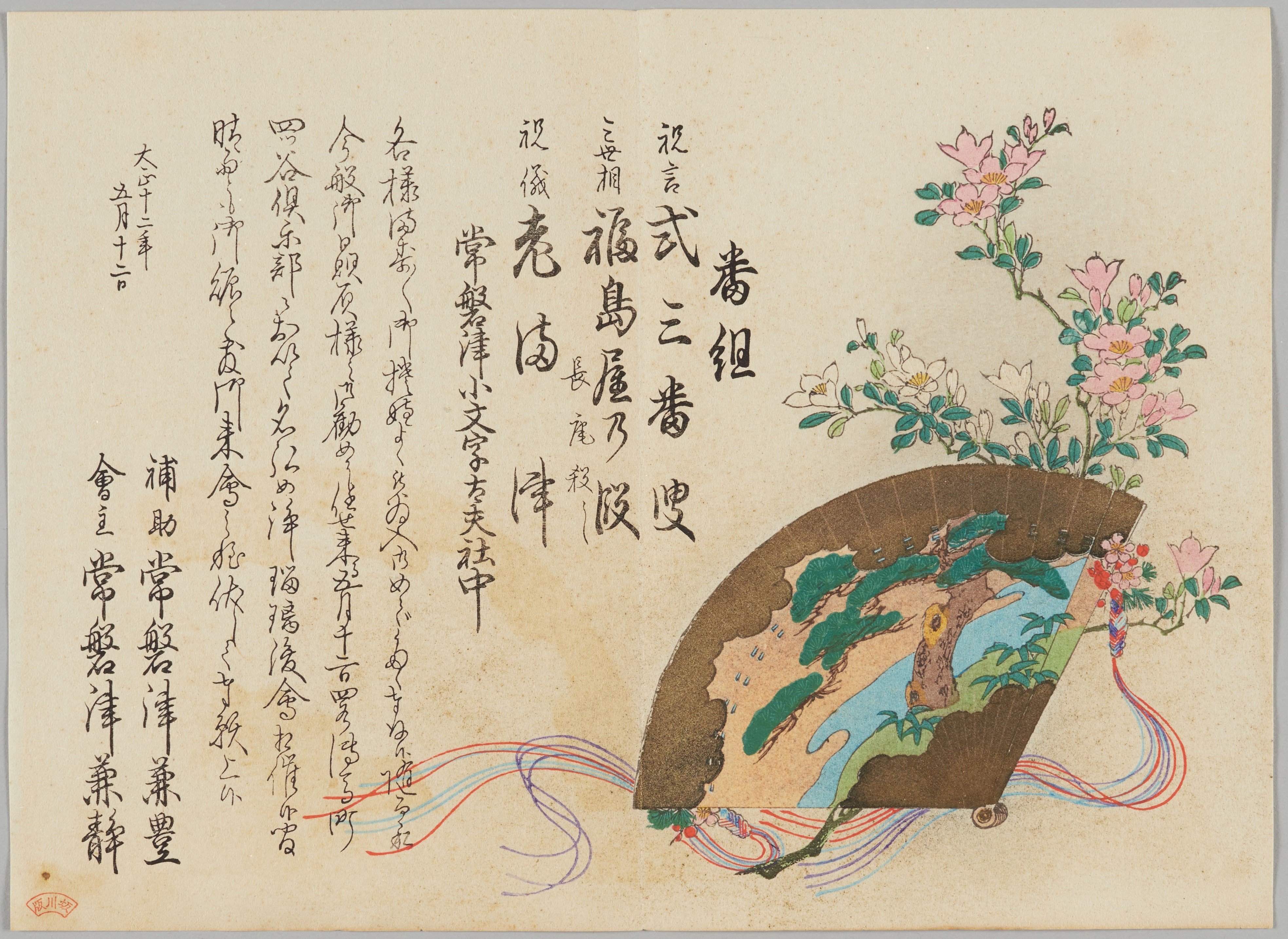
Program print from May 12, 1923. Tokiwazu Kaneshizu was the organizer.
According to Takeuchi Yuichi (ed.), List of Tokiwazu-bushi Performers, vol.4, Kaneshizu was a middle-ranking female joruri performer, and is mentioned in materials from 1919 to 1940.
This print is a new material that has not been studied before.[50393(27-01-09)]
Selected Research 6
Research on the Concept of “History of Japanese Performing Arts” in the Ozawa Shoichi Collection: ” Art,” “Sexuality,” and “Discrimination” in the Historiography of Performing Arts
Principal Researcher
Suzuki Seiko (Associate Professor, Graduate School of Humanities, Osaka University)
Collaborative Researchers
Muto Daisuke (Professor, Faculty of Literature, Gunma Prefectural Women’s University)
Kakinuma Ayako (Specialized Researcher, Kinugasa Research Organization, Ritsumeikan University)
Kyotani Yoshinori (Professor, Gakushuin University)
Seto Tomoko(Associate Professor, Kobe College)
Muto Daisuke (Professor, Gunma Prefectural Women’s University)
Research Objectives
The Ozawa Shoichi Collection includes radio, television, film, and theater scripts performed by Ozawa Shoichi(1929-2012), a shingeki actor, as well as scrapbooks, performance pamphlets, photographs, audiovisual media, and other materials. This study analyzes interviews conducted by Ozawa in the late 1960s, recorded on open-reel tapes and cassette tapes, to elucidate the “history of Japanese performing arts” that Ozawa attempted to portray by seriously approaching the themes of “art,” “sexuality,” and “discrimination.”
Summary of Research
Since the last academic year, our research team hasbeen studying and analyzing the digitization (conducted by the Theatre Museum) of open-reel tapes found in the archives of the Ozawa Shoichi Collection. These tapes contain interviews recorded by Ozawa Shoichi in the late 1960s, in which he spoke with people who were “despised and looked down on by the world” in search of sources for his history of performing arts.This academic year, we worked primarily on the digitization of cassette tapes (conducted by the Theatre Museum and this team). With three new collaborative researchers (Ukai, Kyotani, and Seto) joining the team, we deepened our study of the issues and expanded our perspective on Ozawa’s interviews based on each researcher’s area of interest. After a discussion at a Zoom meeting in August, we gradually understood that Taishū engeki theaters and strip theaters of the past were “‘spaces’ where diverse people were drawn together and gathered” (Ukai). We endeavored to provide the Theatre Museum with reports analyzing the contents of the audio recordings from an academic perspective, to be used as a reference when considering the open/closed status of its audio materials in the future.
From the beginning, the team has been exploring a new question, namely, how museums and archives can handle audio recordings of interviews related to “art,” “sexuality,” and “discrimination,” including contents that could be considered “antisocial” or “potentially disruptive to public order and morals” even today, or that require consideration in terms of human rights. In one of the interviews digitized this academic year, Ozawa’s interviewee made a somewhat snide remark about a prominent colleague (this part was cut from Ozawa’s writings). Although this was very interesting, we concluded that publishing that remark would require further consideration due to the potential invasion ofprivacy (Muto).
As in the last academic year, because of the wide range of occupations of the interviewees, we attempted to conduct a collaborative survey in which experts listened to and discussed the audio recordings (Seto, Suzuki, and research collaborator Kushiya Natsuho). As a case in point, we asked Ikari Sadako, Japan’s first female professional wrestler, to listen to an interview conducted by Ozawa with Obata Chiyo, a fellow female professional wrestler who was close to Ms. Ikari. As aresult, Ms. Ikari was able not only to advise the teambut also to speak spontaneously about herself without needing to be asked questions. This outcome fully demonstrates the appeal of audio materials (Seto).
Continuing on from the last academic year, to understand and archive the historical context of audio recordings, we proceeded with a detailed inventory of scrapbook materials (photo at the bottom right of this page) ordered by Ozawa and produced by a contractor (the inventory was conducted by research collaborator Kabata Ayumi). The team exchanged ideas using a LINE group as well as research meetings, conferences, and e-mails, and ultimately demonstrated that these scrapbook materials can function organically as a database.
To present the above results to the public, in February 2026, we conducted a research meeting at Dogo Onsen(Ehime) to review the audio materials assigned to eachteam member and examine some of the recordings and notes. In addition, the Association for the Studyof Cultural Resources (Secretariat, the University of Tokyo) has asked several team members to present their findings at a research meeting in October 2026 (Kyotani).
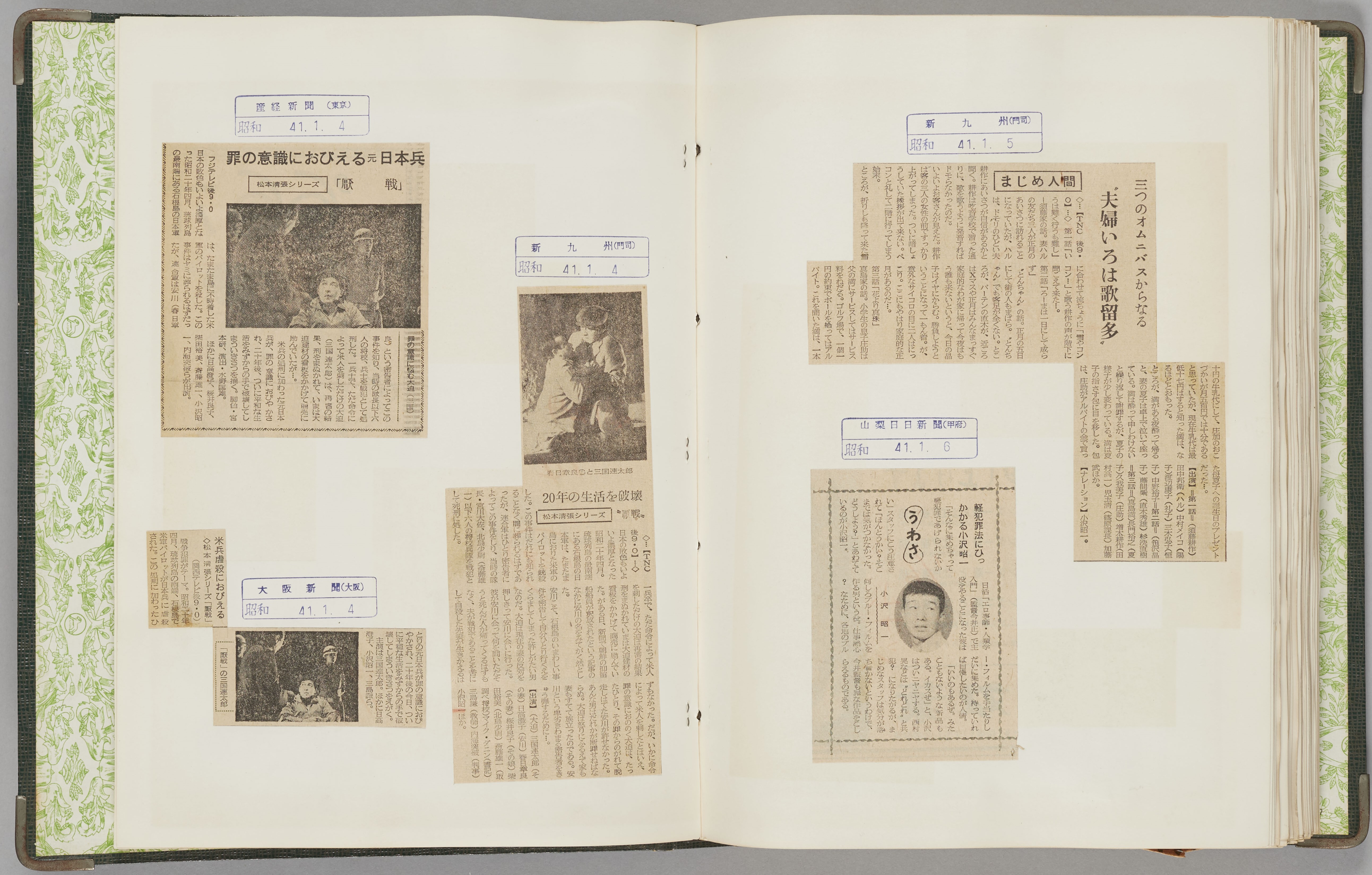
Part of the scrapbook [51717].
On this two-page spread, newspaperclippings about Ozawa that appeared in the Sankei Shimbun,Osaka Shimbun, Shin-Kyushu Shimbun, and YamanashiNichinichi Shimbun are pasted in chronological order.